React vs Next.js: A Complete Comparison for 2026
Category:: Front-End

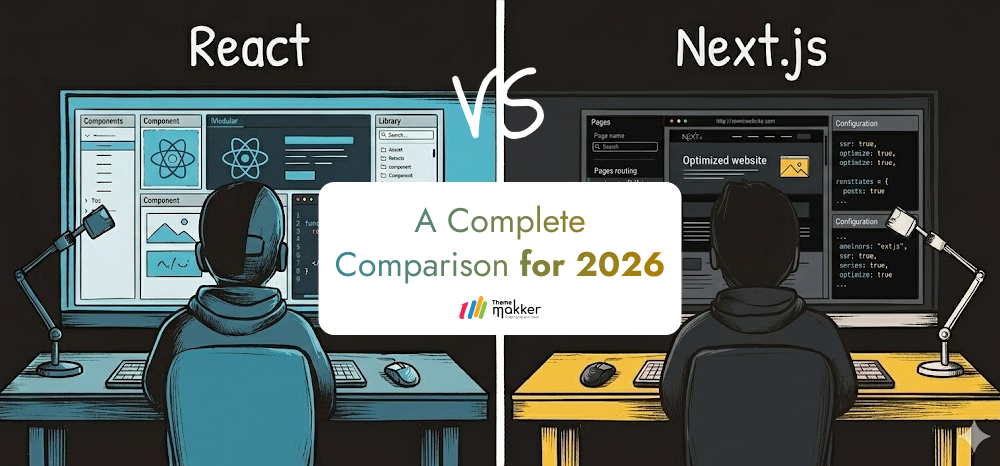
Modern website development has become faster, more interactive, and deeply focused on user experience. Businesses today need web applications that are not only visually appealing but also reliable, scalable, and easy to maintain.
This is where React and Next.js play a major role. React helps developers build flexible user interfaces, while Next.js extends those capabilities by offering built-in tools for better performance and structure.
Both technologies are widely used across startups and enterprises, yet choosing between them can be confusing. Each offers unique strengths depending on the project requirements and business goals.
This blog explains what React and Next.js are, their features, advantages, differences, and when to use each, helping you choose the right option for enterprise-level web applications.
React vs Next.js: A Complete Comparison for 2026
What is React?
React is an open-source JavaScript library created by Meta for building user interfaces. It allows developers to create reusable components that manage their own data and update efficiently as information changes, ensuring a smooth, fast user experience.
Key Features of React
- Virtual DOM ensures fast updates by minimizing direct changes to the browser.
- Component-based architecture enables reusable, modular code blocks.
- Unidirectional data flow makes the application state very predictable.
- JSX syntax combines JavaScript and HTML for intuitive coding patterns.
- Extensive library support provides solutions for almost any development task.
- Hooks allow functional components to manage state and side effects.
- Strong community backing ensures constant updates and reliable security patches.
Top 6 Advantages of React
- Easy to learn and adopt for developers with basic knowledge.
- Supports reusable code, significantly reducing development time.
- Strong ecosystem with tools, libraries, and community support available.
- Flexible usage for different project sizes and business requirements.
- Improves application speed and user experience across devices.
- Allows quick updates without affecting the entire application structure.
Limitations of React
- Requires additional tools to complete the application development setup.
- Initial setup may be confusing for beginners without guidance.
- Frequent updates require developers to stay continuously updated.
- Managing large applications needs proper structure and planning.
- Documentation can feel overwhelming due to the vast ecosystem resources.
What is Next.js?
Next.js is a powerful development framework built on top of React that simplifies the creation of production-ready websites. It provides built-in solutions for routing and image optimization to help developers build faster, more SEO-friendly applications.
Key features Next.js offers
- Excellent search engine visibility right out of the box today.
- Faster page loading times significantly enhance the overall user experience.
- Zero configuration setup allows developers to start coding immediately.
- Improved developer experience through simplified routing and data fetching methods.
- Automatic code splitting ensures only the necessary code is loaded initially.
- Enhanced security features protect sensitive data during rendering.
Limitations of Next.js
- The framework structure can feel restrictive for very unique projects.
- Build times can increase as the number of pages grows.
- Hosting options are often best optimized for the Vercel platform.
- Smaller community compared to the massive React ecosystem of users.
- Overkill for simple websites that do not need advanced features.
Comparison Table: React Vs. Next.js
Here’s a brief comparison of what both offer.
| Aspect | React | Next.js |
|---|---|---|
| Type | Library for building user interfaces | Framework built on React for full applications |
| Setup | Requires manual setup and additional tools | Comes with built-in features and configuration |
| Performance | Depends on the implementation choice | Optimized by default for better performance |
| Routing | Needs external libraries for routing | Built-in routing system available |
| Flexibility | Highly flexible for custom development needs | More structured with a predefined approach |
| Use Case | Suitable for dynamic interfaces and custom apps | Ideal for full applications with performance focus |
| Learning Curve | Easier for beginners to start | Slightly higher due to added features |
The Superior Choice Between the Two: React Vs. Next.js
Deciding if one is better depends entirely on your project goals. Next.js is often seen as a superior all-in-one solution because it includes features like routing and optimization that React lacks by default.
However, React remains the better choice for those who want complete control over their stack.
When to Opt for React Over Next.js?
React is the better option when you are building highly dynamic dashboards or internal tools where SEO is not a major concern. It provides the freedom to design your own architecture.
Ideal for building complex and custom single-page applications. Best for projects that require a unique and specific architecture. Useful when you already have a backend and only need UI. Perfect for developing internal enterprise tools with many interactive elements.
When to Opt for Next.js Over React?
Next.js is the preferred choice for public-facing enterprise applications that require high speed and excellent search engine rankings to attract and retain users in a competitive market.
Essential for websites that need top-tier search engine rankings. Great for large-scale e-commerce platforms with many product pages. Best for applications where fast initial page loading is critical. Useful for teams that want a standardized and predictable workflow.
The Future of Development Tools
It is unlikely that Next.js will ever fully replace React because it actually depends on React to function. They serve different purposes in the development world. React provides the foundational building blocks, while Next.js offers a refined way to assemble them into a high-performance web application.
Conclusion
React and Next.js both offer powerful solutions for building modern web applications. React provides flexibility and control, making it ideal for customized projects, while Next.js simplifies development with built-in features and improved performance.
The choice between them depends on your project requirements, team skills, and long-term goals.
As technology evolves, both will continue to remain relevant, supporting businesses in creating scalable and user-friendly applications. Understanding their strengths ensures better decision-making and successful project outcomes.
If you are planning to build a modern web application, explore Thememakker for expert React and Next.js development solutions tailored to your business needs.
Frequently Asked Questions
-
Q:: How does Next.js work better than React?
A:: Next.js builds on React by adding built-in routing, faster page loading, and better structure. It reduces setup effort and improves performance out of the box. This makes it easier for teams to create full web applications without relying heavily on additional tools or manual configuration.
-
Q:: What are the use cases for React and Next.js?
A:: React is ideal for building dynamic user interfaces, dashboards, and applications that require flexibility. Next.js is better suited for full web applications that need faster loading, better search visibility, and structured development, such as business websites, e-commerce platforms, and enterprise-level applications with performance-focused requirements.
-
Q:: How do Next.js and React work together?
A:: Next.js is built on top of React, meaning it uses React for building user interfaces. Developers write React components, and Next.js enhances them with features like routing and faster loading. Together, they enable teams to build complete applications with both flexibility and performance improvements within a single development environment.
Recommended Posts
97.9%
Projects Delivered On-Time

5,000+
Creatives & Agencies Trust Us.

Development Service?
We can provide at affordable price.


Awwwards, Design Nominees, CSSLight, Best CSS and more





THEMEFOREST
Exclusive Author
Boost Backend Efficiency with Cutting-Edge Web Technologies
Accelerate your backend development with our premium admin dashboard templates powered by today’s top frameworks and libraries—Bootstrap, Tailwind CSS, React, Vue.js, Angular, Laravel, Node.js, WordPress, Next.js, ASP.NET, and more. Whether you're building a SaaS platform, CRM, or internal tool, our dashboards offer clean design, modular code, and full responsiveness to help you build faster and smarter.