The Business Impact of Agentic AI in Enterprise Technology
Category:: Artificial Intelligence (AI)

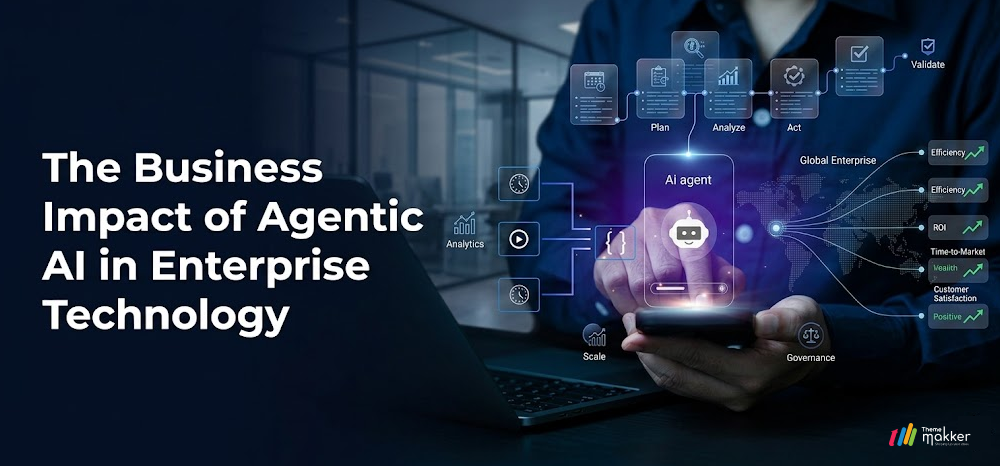
Artificial intelligence is no longer limited to chatbots and automated replies. Businesses today want systems that can plan tasks, make decisions, and execute actions with minimal human input. This shift has led to the growing popularity of agentic AI in enterprise web solutions.
Companies across industries are using intelligent systems to improve customer support, automate internal operations, manage workflows, and deliver faster digital experiences. Unlike traditional automation tools, agentic systems can understand goals, plan actions, and adapt to changing situations. This makes them highly valuable for modern enterprises that depend on speed and accuracy.
As organizations continue their digital transformation journey, understanding what agentic AI is and how it works has become important for business leaders, developers, and technology teams. From e-commerce platforms to SaaS applications, agentic systems are changing how enterprise web solutions operate.
What is Agentic AI?
Agentic AI refers to intelligent systems that can independently perform tasks by analyzing information, making decisions, and taking action to achieve a defined objective. Instead of waiting for constant human instructions, these systems can plan steps, monitor progress, and adjust actions when required.
Traditional AI systems usually respond to specific prompts. Agentic systems go further by acting like digital assistants capable of handling complete processes.
For example, a traditional chatbot may answer customer questions. An agentic system can answer questions, create support tickets, assign issues to teams, follow up with customers, and generate reports without manual supervision.
This ability to work through multi-step tasks makes agentic AI highly valuable for enterprise web applications.
Why Enterprises Are Adopting Agentic AI
Businesses today face increasing pressure to improve efficiency while reducing operational costs. Enterprise web solutions are expected to deliver faster results, better user experiences, and continuous availability.
Agentic AI helps companies meet these expectations by automating decision-making and reducing repetitive work.
Some major reasons enterprises are adopting these systems include
-
Improved Productivity
Employees often spend hours managing repetitive tasks such as data entry, email responses, scheduling, and report creation. Agentic systems can handle these activities automatically, allowing teams to focus on strategic work.
-
Better Customer Experience
Modern customers expect quick responses and personalized interactions. Agentic systems can analyze customer behavior, provide accurate recommendations, and solve problems faster than manual processes.
-
Faster Business Operations
Organizations can automate entire business processes using intelligent workflows. This reduces delays and improves operational speed.
-
Smarter Decision Making
Agentic systems can analyze large amounts of data in real time and provide useful insights for better business decisions.
Agentic AI Use Cases in Enterprise Web Solutions
There are several practical agentic AI use cases across industries. Enterprises are integrating these systems into web platforms to improve both internal and customer-facing operations.
-
Customer Support Automation
One of the most common use cases for agentic AI is customer service automation. Intelligent agents can manage conversations, resolve support issues, escalate problems when necessary, and maintain communication history.
This improves response times while reducing workload for support teams.
-
E-commerce Management
Online stores use agentic systems to monitor inventory, recommend products, manage pricing, and track customer behavior. These systems help businesses increase conversions and improve customer retention.
-
HR and Recruitment
Recruitment platforms are using intelligent agents to screen resumes, schedule interviews, answer candidate questions, and track hiring progress.
This saves time for HR teams and improves hiring efficiency.
-
Project Management
Agentic systems can monitor project timelines, assign tasks, generate reminders, and provide progress updates. This helps teams stay organized and complete projects faster.
-
IT Operations
Many enterprises use intelligent agents to monitor servers, detect system issues, and perform automated troubleshooting. This reduces downtime and improves system performance.
Agentic AI Workflows in Modern Enterprises
Modern businesses rely heavily on automation. However, basic automation tools often fail when workflows become complex. This is where agentic AI workflows become useful.
These workflows combine reasoning, planning, and action execution into a connected process.
For example, consider a sales workflow
- A customer submits an inquiry through a website.
- The system analyzes the request.
- It identifies customer intent.
- It sends personalized recommendations.
- It schedules a sales meeting.
- It updates the CRM automatically.
- It generates follow-up reminders.
Instead of multiple disconnected tools, a single intelligent system manages the entire workflow.
These advanced agentic AI workflows help businesses reduce manual effort while improving consistency and speed.
Agentic AI Examples Across Industries
Understanding real business applications makes the technology easier to visualize. Several companies are already implementing intelligent agents in enterprise environments.
Here are some practical agentic AI examples
-
Banking Platforms
Financial institutions use intelligent agents to detect suspicious transactions, assist customers, and automate loan processing.
-
Healthcare Systems
Hospitals and healthcare providers use AI-driven systems to schedule appointments, organize patient records, and assist with medical documentation.
-
SaaS Companies
Software companies use agentic systems to onboard users, monitor application usage, and improve customer engagement.
-
Logistics and Supply Chain
Shipping and logistics companies use intelligent agents to optimize delivery routes, manage warehouse operations, and track shipments.
-
Marketing Platforms
Marketing teams use agentic systems to generate reports, schedule campaigns, analyze audience behavior, and optimize advertising performance.
These agentic AI examples show how businesses are moving beyond simple automation toward intelligent decision-based systems.
The Role of Agentic AI Frameworks
Building intelligent enterprise solutions requires structured development tools and architectures. This is where agentic AI frameworks play an important role.
Frameworks help developers create systems capable of reasoning, planning, and task execution. They provide the foundation needed to build scalable enterprise applications.
Some common features offered by agentic AI frameworks include
- Task management
- Workflow orchestration
- Memory handling
- Decision-making logic
- Tool integration
- Multi-agent collaboration
These frameworks allow enterprises to build reliable AI-powered systems without creating everything from scratch.
As demand for intelligent automation increases, more businesses are exploring modern development frameworks to support enterprise-scale deployments.
Benefits of Agentic AI for Enterprise Web Solutions
The rise of intelligent agents is creating measurable business value across industries.
-
Reduced Operational Costs
Businesses can automate repetitive work and reduce dependency on manual processes. This lowers operational expenses over time.
-
Increased Efficiency
Intelligent agents can complete tasks faster than traditional workflows. This improves productivity across departments.
-
Continuous Availability
Agentic systems can operate around the clock without interruption, ensuring consistent service delivery.
-
Better Accuracy
Automated systems reduce human error in tasks such as data processing and reporting.
-
Scalability
Businesses can manage increasing workloads without significantly expanding teams.
These advantages make agentic AI a strong investment for enterprises focused on growth and digital transformation.
Challenges Businesses Should Consider
Although the benefits are significant, enterprises should also understand the challenges associated with adoption.
-
Data Privacy
AI systems often require access to large amounts of business and customer data. Companies must ensure proper security and compliance measures.
-
Integration Complexity
Connecting intelligent agents with existing enterprise systems may require technical expertise.
-
Employee Adaptation
Teams may need training to work effectively with AI-driven workflows.
-
Monitoring and Governance
Businesses should continuously monitor AI systems to ensure accuracy, fairness, and compliance.
Addressing these challenges early helps organizations build reliable and responsible AI solutions.
The Future of Agentic AI in Enterprise Technology
The future of enterprise software is moving toward intelligent and autonomous systems. Businesses are increasingly seeking platforms that can manage operations with minimal manual oversight.
As AI technology evolves, agentic systems will become more capable of handling complex business activities. Future enterprise solutions may include:
- Fully automated customer support ecosystems
- Intelligent sales assistants
- Self-managing business workflows
- AI-powered digital operations centers
- Advanced collaboration between multiple intelligent agents
The growth of cloud computing, machine learning, and enterprise automation tools will further accelerate adoption.
Organizations that invest early in intelligent systems will likely gain a competitive advantage in efficiency, customer experience, and operational scalability.
Conclusion
The rise of agentic AI is transforming enterprise web solutions across industries. Businesses are no longer limited to simple automation tools. They now have access to intelligent systems capable of planning, decision-making, and independent task execution.
From customer support and ecommerce to IT operations and workflow management, enterprises are discovering valuable agentic AI use cases that improve efficiency and reduce operational burden.
Understanding what agentic AI is, exploring practical implementations, and adopting the right agentic AI frameworks can help organizations prepare for the future of digital business.
As technology continues to evolve, intelligent workflows and autonomous systems will become a standard part of enterprise operations. Companies that embrace this shift early will be better positioned for long-term growth and innovation.
Are you planning to incorporate agentic AI in your business workflows? Drive smarter growth with Thememakker’s AI services. From intelligent automation to custom AI solutions, we help businesses improve efficiency, simplify operations, and create digital experiences that deliver measurable results.

Frequently Asked Questions
-
Q:: How does agentic AI differ from traditional AI?
A:: Traditional AI mainly responds to user commands or performs predefined tasks. Agentic AI can independently plan actions, make decisions, and complete multi-step processes to achieve a goal. It operates with greater autonomy and can adapt to changing situations without requiring constant human instructions.
-
Q:: What are some real-world examples of agentic AI?
A:: Common examples include customer support systems that resolve issues automatically, e-commerce platforms that manage inventory and recommendations, and logistics tools that optimize delivery routes. Enterprises also use intelligent agents for recruitment, IT monitoring, healthcare scheduling, and automated business reporting.
-
Q:: What are the benefits of agentic AI?
A:: Agentic AI helps businesses improve productivity, reduce operational costs, and deliver faster customer experiences. It also minimizes repetitive work, supports continuous operations, improves accuracy, and allows organizations to scale processes more efficiently without depending heavily on manual intervention.
-
Q:: How does agentic AI improve efficiency?
A:: Agentic AI improves efficiency by automating complete workflows instead of isolated tasks. It can analyze data, make decisions, trigger actions, and monitor results in real time. This reduces delays, reduces human effort, and helps businesses complete operations faster and with greater consistency.
-
Q:: What are the best use cases for agentic AI?
A:: Some of the best use cases include customer service automation, workflow management, e-commerce personalization, recruitment support, IT operations, and sales automation. These applications help enterprises streamline operations, improve response times, and deliver better experiences for customers and employees alike.
Recommended Posts
97.9%
Projects Delivered On-Time

5,000+
Creatives & Agencies Trust Us.

Development Service?
We can provide at affordable price.


Awwwards, Design Nominees, CSSLight, Best CSS and more





THEMEFOREST
Exclusive Author
Boost Backend Efficiency with Cutting-Edge Web Technologies
Accelerate your backend development with our premium admin dashboard templates powered by today’s top frameworks and libraries—Bootstrap, Tailwind CSS, React, Vue.js, Angular, Laravel, Node.js, WordPress, Next.js, ASP.NET, and more. Whether you're building a SaaS platform, CRM, or internal tool, our dashboards offer clean design, modular code, and full responsiveness to help you build faster and smarter.